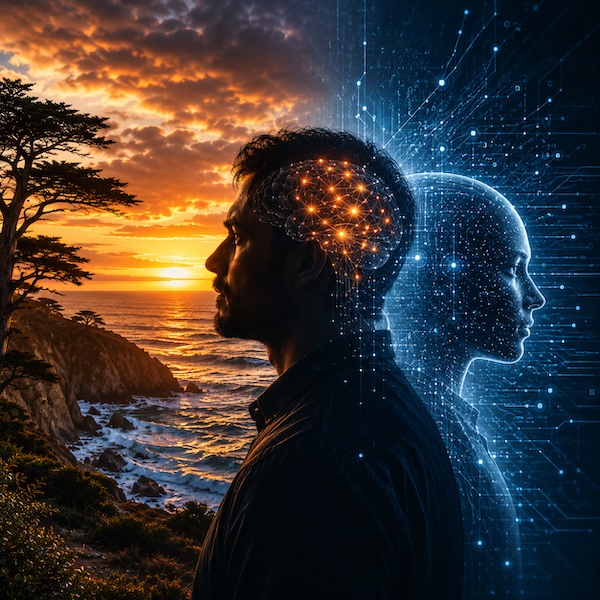
Why The Current AI Is "Not Even Close" To AGI
(Part 1 of 3)

(Part 1 of 3)
AI - Artificial Intelligence is said to be evolving fast heading straight for AGI - Artificial Generalized Intelligence. My view on this is simple. The methods inherent to current AI builds are all centered around having a very big jumbled bucket of data but with extraction tools that work very fast (in parallel actually) to pull that jumble apart and make something that resembles cogent thought. It will take a lot more than that to actually have a system achieve AGI.
Imagine a little fishing boat and the tackle box has spilled onto the floor of the boat. The lures and line and sinkers and such are all a tangled mess. That's how a data set exists for AI. The magic happens by AI's ability to rapidly pick apart that mess and extract what is needed. It is impressive. It helps us to speed up our work, but it is NOT yet an intelligent system.
Actual Experience Drives Our Intellect
I recently came back from a business trip to the Bay Area of California. To make the trip a little more fun, and after weeks of unrelenting sub-zero temperatures at home, we made a family trip of it. In March, weather can be hit or miss in San Francisco and the surrounding area. For us, it was a hit.
Record-breaking temperatures in fact and not a spot of rain. Leading up to the business events in San Jose, we took some overnights and ventured off the beaten path to hit Santa Cruz, Monterey, Carmel and a few spots in between. There, we checked an important item off the bucket list of anyone who loves a scenic drive: 17-Mile Drive. Starting in Monterey we made our way south along the coastline past a dozen golf courses on our left (Pebble Beach for those who know) and the most scenic views of the Pacific Ocean one can take in on the right.
The road was winding and hilly, but mostly clear of traffic. The vistas: breathtaking. Back at our hotel, we dined at a seafood restaurant that reaches out into Monterey Bay on a kind of pier teasing the fish and crab below us with what fate might be theirs if they didn't mind whose nets were intent on entangling them.
That little stretch along the Bay is called Cannery Row. It's where the sardine trade at the turn of the last century boomed. It is also the setting of a famous novel by American writer John Steinbeck, who notably hailed from the area too. The journey was highly experiential, made all the more so by how it contrasted with the abstract world of AI at the NVIDIA GTC conference we subsequently attended in nearby San Jose.
Do you see how in 4 short paragraphs, I imbued the prose with direct "sensory" recollections? It is that co-mingling of experiential contemplation that is the a primary factor in making us sentient.
With all the talk of AI, the fear-mongering, the opportunity-grabs, the endless news cycle, the promise of a future of leisure while robots do our bidding, the fear that those same robots might want to take us over, and so on, I could not help but revel in the sensory overload of that very non-AI jaunt we made. At this point in the technology evolution, AI systems are so decisively divorced from possessing the vast inputs we humans have that form our "Generalized Intelligence" that I came to a very confident conclusion.
We are not even close to AGI yet.
It's true. It will not be any time soon that an AI robot will feel the grandeur of a beautiful vista or smell the seaside air, the musical soundtrack of exotic birds and the aroma of delicious foods tantalizing a FELT hunger and encouraging a desirous appetite. Not any time soon will a robot be able to experience those things while also reflecting back with a longing to a childhood beach trip becoming overwhelmed by a flood of emotional sentiment that can ONLY come from such reflections.
Yet, it is the interplay of these cross-modal sensory / perception / conception systems that actually constitute Generalized Intelligence. One might argue that many humans have not even achieved "generalized intelligence" (haha! but that is another story). For now, Artificial Generalized Intelligence (AGI) remains a long way off.
The Brain / Nervous System Integration
I remember seeing the Body Exhibit in New York City where human cadavers had been dissected to give direct insight to our insides. Most memorable was a human brain with all of its nerve fibres intact from head to toe. It was literally all one continuous flow of tissue. And, it demonstrated quite visibly that our brain is more than just an isolated couple of hemispheres in our craniums. The brain and spinal cord are all really just one multi-branched organ.
We tend not to think of our brain that way. We tend to separate it from all of those limbs that contain the nerve fibres. Yet, it is those main branches and sub-branches coming off the spinal cord that form a continuous tangle of input paths for the gray matter between our ears to then perceive the world and formulate "intelligent" observations. In essence, we as humans are just a bundle of nerve fibres connected to a central processing unit and supported by organs for managing resources and limbs to move us around.
Sense of touch, taste, sight, hearing, smell, etc. are just the start. These all feed that great CPU between our ears. From there, a magical consciousness emerges that can weave all of that information into the thing we call "intelligence".
Senses → Perception → Concept
First and foremost, we get memory across all sensory experiences. It's why a certain smell can take you back to your childhood or to some other lived experience. We also have reason, which gives us the ability to organize what we have perceived into concepts that can be set into a kind of latticework of understanding.
We get the power of deduction and induction which help us align an inner world of our consciousness with the real world we have experienced. We have a choice to focus these systems and derive deeper, more accurate understanding OR to de-focus and effectively bury our heads in the sand. That is to say that unlike a computer which is fully on or off, humans can induce an inner fog to hide the hurtful things or to obfuscate the complicated things.
AI has none of that.
To whatever degree we bring effort to our thoughts, we get a similar outcome of cohesiveness to our thoughts. These, in turn, feed our motivations, emotions, reactions, responses, creativity, recognition and recall memories, emotional memories, problem-solving, induction, deduction, pattern recognition across input modes, love (and hate), longing, craving, insight, desires, disgusts, moral judgment, ethical judgment, spiritual connection, synthesis of abstraction from random scraps of information, planning for the future, predictive powers, rumination for what might go wrong, regret for what DID go wrong... and more.
AI has none of that.
Picture the feeling of awe when one beholds a mountain view or a waterfall, a sunset or hears a beautiful composition. The pulse will increase to provide ample blood flow to all the intake mechanisms of our body for the purpose of processing the experience. Eyes dilate to take in more information. Eyes literally widen.
Alertness peaks. We perspire to keep our temperature in check. Perhaps we have a salivating response... or our mouths go dry from the redirection of our internal resources elsewhere. Small pains are numbed. Our focus sharpens. In a word, we savour the moment.
Then, we record the moment across brain systems for future recall. The depth and breadth of what makes us intelligent is profound.
AI has none of that.
An example comes to mind for me. I remember hearing the band Rush perform "Red Sector A" live in concert back around 1984. The band's singer, Geddy Lee, sang (no, "wailed") so extra passionately on that song that it gave me body-shaking goosebumps. Somehow, he was conveying such primal human emotion as if directly from his voice straight to me alone.
At the time, I only roughly knew that the song's lyrics by Neil Peart spoke to what it must have been like for prisoners inside a Nazi concentration camp during the Holocaust. Later, reading Victor Frankl's book, In Search of Meaning, I found direct prose references that Peart drew upon for the lyrics. More importantly, he (and Geddy) drew upon the fact that Geddy's mother and father had themselves survived concentration camp horrors during the war.
To this day, forty years later, every single time I hear Geddy Lee sing the climax line of the song: "...and I must help my mother stand up straight", I get shivers down my spine. It is a direct resonance to what I felt (and recorded to the deeper parts of my memory) all those years ago.
AI has none of that.
Stay tuned for Part 2!
Click below to proceed to Part Two of Three.
We seek to complement the excellence of your company with the excellence of our approach as your digital services partner. Reaction Internet is a value-driven firm operating with strict business ethics to provide professional, reliable solutions to meet and exceed your web system expectations.
"Forging Innovation From The Fires Of Tradition"™


Reaction Internet is a division of ACTION Corporation
Copyright © 1994-2026. ACTION Corporation. All Rights Reserved.